
Remove lint buildup, improve dryer airflow, and reduce fire risk with a clean, non-invasive dryer vent cleaning service.
Looking up clothes dryer vent cleaning near me? Comfort Clean cleans clothes dryer vents in homes and commercial buildings across Toronto and the GTA, with the price posted up front and no upsells at the door.
Dryer vent cleaning in Toronto is essential for both commercial properties and homes where dryers are used regularly. Over time, lint buildup inside the vent restricts airflow, increases heat, and raises the risk of fire. Professional vent cleaning helps restore proper airflow, support safe operation, and keep dryers performing efficiently.
Regular dryer vent service helps restore proper airflow, supports safe operation, and keeps your dryer working efficiently — especially in homes where the dryer is used frequently or the vent line is long or difficult to access.
Benefits of regular dryer vent cleaning:
The dryer vent is really the exhaust duct that carries hot, damp air outside, so dryer vent cleaning, dryer duct cleaning, and dryer air duct cleaning all describe the same work – clearing lint from the full dryer vent duct, from the machine to the outside wall. Families searching for dryer vent cleaning Toronto and across the GTA have trusted Comfort Clean, family run since 1980, for exactly that.

Clothes dryer vent cleaning is the same job in every home: clear the lint from the back of the dryer all the way to the outside cap. What changes is the route the vent takes, and across Toronto and the GTA that route depends on when and how your home was built.
In the postwar bungalows and side-splits found all over North York, the laundry is usually in the basement and the vent leaves through the wall just above grade. The run is short, but the outside hood sits low, where leaves, grass clippings and snowdrifts can block it. Behind the dryer we often find an old foil or vinyl transition hose that has been crushed flat against the wall for years.
Newer two-storey houses in Vaughan, Richmond Hill and Markham often put the laundry on the second floor. That vent travels between floor joists or inside a wall to reach the outside, with more elbows and low spots where lint settles and packs. It is a longer clean, which is why second-floor laundry has its own price.
Townhouses have fewer outside walls to vent through. In freehold and condo townhouses the dryer line can run the full depth of the unit to reach the front or back wall, and in stacked or back-to-back towns it may go up to the roof instead. Long runs with several turns are where we pull out the heaviest lint.
A vent that climbs through the attic works against gravity. When the dryer stops, lint and moisture slide back toward the bottom elbow. In winter, warm, damp exhaust meets a cold attic, condenses, and turns the lint into a sticky paste that catches the next layer. Joints in the attic can also pull apart, so the dryer blows humid air into the insulation instead of outside.
We clear the full run, check the connections we can reach and confirm that air is leaving at the roof or gable cap. These vents take the most time and access work, which is why the attic rate is the highest posted price.
In a condo, the dryer duct usually runs through a ceiling bulkhead to an outside wall or a shared riser, and some buildings add an in-line booster fan to push the lint that far. Access goes through your concierge or property manager, and we arrange it before the visit. Our condo duct cleaning service covers the rest of the suite, including the supply vents and the fan coil.
One honest note for condo owners: a ventless condenser or heat pump dryer has no exhaust line, so there is nothing for us to clean. Clean its filters the way the manual describes.
A blocked dryer vent rarely fails all at once. Drying slows down over months, and most people blame the dryer first. These are the signs we hear about most:
When the vent turns out to be clear and the dryer still overheats or will not heat at all, the fault is likely inside the dryer, which is a job for an appliance technician. We clean vents; we do not repair dryers.
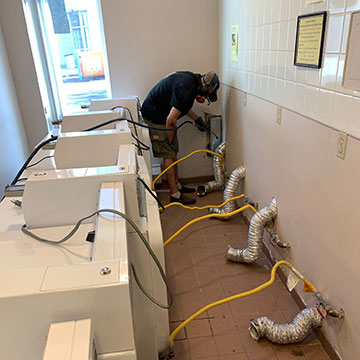
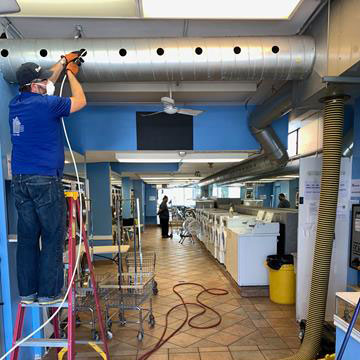
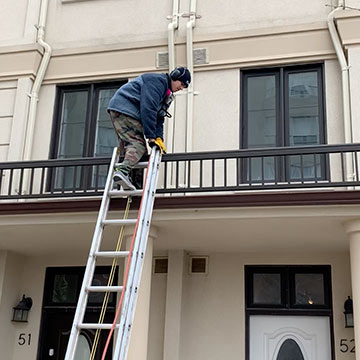
Businesses that operate dryers on a daily basis face higher fire risk, greater airflow restrictions, and increased mechanical wear due to heavy use. In commercial environments, lint buildup accumulates faster and can quickly create safety hazards, operational delays, and compliance concerns.
Professional commercial dryer vent cleaning in Toronto is especially important for:
Our technicians use specialized high-pressure air tools to remove lint buildup throughout the entire exhaust system — including long or multi-turn commercial vent lines — without invasive structural work.
Whether you manage a multi-unit residential building or operate a commercial laundry facility, scheduled vent maintenance helps protect your property, your tenants, and your business operations.
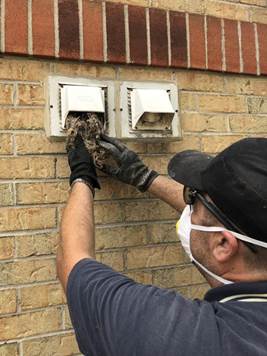
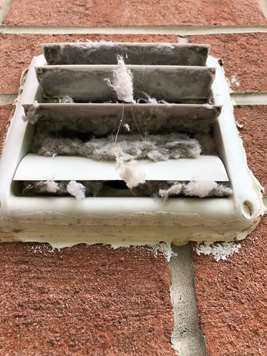
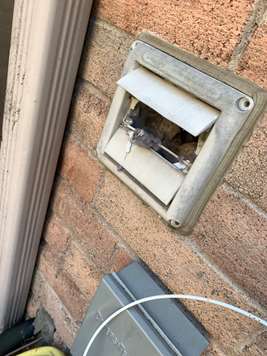
Professional vent service prices depend on the length of the vent, the number of turns, and how easily the vent can be accessed. Final pricing is confirmed after a brief inspection to ensure safe and thorough cleaning.
Our vent cleaning service focuses on restoring safe airflow through the entire exhaust system. Each visit is performed carefully to remove lint buildup, identify potential issues, and ensure the vent is clear from the dryer to the exterior outlet.
Whether you need home dryer vent cleaning for a single house or service for a whole condo laundry room, we clear the clothes dryer vent from the dryer to the exterior outlet. We cover Toronto, Vaughan, Richmond Hill, Markham, Newmarket, and Thornhill, so a crew is usually close by.
Dryer vent cleaning in Toronto costs $280 for a main floor or basement dryer, $320 for a second-floor laundry and $480 for a vent that runs through the attic, at our posted residential prices. We confirm the final price after a brief inspection and before any work starts, so you know the total up front.
The tier follows where the dryer sits and how far the exhaust has to travel. This is what each one usually looks like in GTA homes:
| Where the dryer vents | Posted price | Typical run | What we check first |
|---|---|---|---|
| Main floor or basement | $280 | A short run through an outside wall, close to ground level | The transition hose behind the dryer, the hood flap, leaves or snow at a low exit |
| Second floor | $320 | A longer run between floor joists or inside a wall, with more turns | Elbows and low spots where lint packs, access to an outside hood at second-storey height |
| Attic | $480 | A vertical run up through the attic to a roof or gable cap | Loose or separated joints, damp lint, attic access and the cap itself |
| Added to an air duct cleaning visit | The same tier price ($280, $320 or $480), priced separately from the duct package | Dryer vent cleaning done in the same visit as your air duct cleaning | Your vent location, confirmed by phone before booking |
Within each tier, the inspection looks at length, turns and access. A dryer squeezed into a closet, an outside cap high on a wall or a run with many elbows takes longer, and we tell you before starting if that changes the price. A vent that has not been touched in a decade takes longer too, and we would rather spend that time than leave a plug of lint halfway down the line.
When you compare dryer vent cleaning cost between companies, ask what the price covers. A very low price sometimes means only the lint screen slot and the first stretch of hose behind the dryer get cleaned. Ours covers the full line from the dryer to the outside cap, with airflow checked at the end. Full package details for duct work are on our duct cleaning prices page.
Professional dryer vent cleaning follows a step-by-step process designed to safely remove lint buildup and restore proper airflow without damaging the vent or surrounding areas.
We start by inspecting the dryer vent system, including the transition duct and exterior vent cap, to identify lint buildup, airflow restrictions, or access challenges.
Using professional cleaning tools, lint and debris are carefully removed from the entire vent line, from the dryer connection to the outdoor exhaust point.
After cleaning, airflow is checked to confirm that the vent is exhausting properly and heat is being safely carried outside.
We complete the service with a final inspection to ensure the dryer vent is clear, secure, and operating safely.
Our office is at 4949 Bathurst St, Unit 8 in North York, at Bathurst and Finch just south of Steeles, so our crews are close to most of the city and York Region. We clean dryer vents across Toronto, including North York, Scarborough and Etobicoke, and just across Steeles in Thornhill. To the northwest we cover Vaughan, including Woodbridge, Maple and Concord; up Yonge Street we serve Richmond Hill and Newmarket; and to the northeast, Markham. West of the city we also book dryer vent cleaning in Mississauga and Brampton. To book a visit anywhere in the GTA, call 905-738-1878, 8am to 6pm, seven days a week.
Maintaining commercial and residential dryer exhaust systems is not only a matter of efficiency — it is also connected to fire safety standards and building maintenance responsibilities in Canada.
The following official resources provide guidance related to dryer vent maintenance, fire prevention, and building safety:
For most commercial properties — including condo buildings, laundromats, hotels, and healthcare facilities — dryer exhaust systems should be inspected and cleaned at least once per year. High-usage facilities may require more frequent maintenance depending on lint buildup and system design. Regular service helps reduce fire risk and maintain safe airflow.
The Ontario Fire Code requires building owners and property managers to maintain equipment in safe operating condition. While it does not specify an exact cleaning interval for dryer vents, clogged exhaust systems that create fire hazards may be considered a safety violation. Routine maintenance supports compliance with fire safety standards.
Yes. While cleaning the lint trap is important, it only captures a portion of lint. Over time, lint still accumulates inside the vent line where it cannot be reached without professional equipment.
Yes. When airflow is restored, dryers operate more efficiently, often reducing drying time and unnecessary energy consumption. This can lower operational costs in both residential and commercial settings.
Most residential services take 45–90 minutes. Commercial properties may require additional time depending on vent length, system complexity, and access. A technician will assess the exhaust line before service begins.
In multi-unit residential buildings, responsibility typically falls to the property owner, landlord, or condominium corporation — especially when dryer exhaust systems are shared or connected to common infrastructure. Scheduled maintenance helps reduce liability and protect tenants.
Yes. Buildings with multiple dryers — such as condominium complexes, apartment rentals, hotels, or laundromats — typically require scheduled inspections and maintenance to prevent lint accumulation and airflow restrictions. In high-usage environments, buildup occurs faster and can increase fire risk or cause operational disruptions.
Property managers often implement annual or semi-annual inspections to maintain safe exhaust performance and reduce potential liability.
For most households, once a year is a sensible schedule. A small household running a few loads a week on a short basement vent can often go two years. Clean every year or sooner with a large family, pets, a long second-floor or attic run, or when loads start taking longer to dry. In between, clean the lint screen after every load.
Comfort Clean’s posted residential prices are $280 for a main floor or basement dryer, $320 for a second-floor laundry and $480 for a vent that runs through the attic. The final price is confirmed after a brief inspection of the vent’s length, turns and access, before any work starts. Dryer vent cleaning is priced separately from our air duct cleaning packages, and it can be added to a duct cleaning visit at the same posted price.
Partly. You can clean the lint screen, vacuum the slot it sits in, pull the dryer out to check the transition hose, and clear lint from the outside hood. A brush kit can handle a short, straight basement run. Long runs, second-floor and attic vents, condo bulkheads and vents with many turns are better left to a professional, because rods can disconnect joints or push a clog deeper.
Dryer manufacturers recommend rigid metal duct and say never to use plastic. Flexible foil duct should only be used if your dryer’s manual specifically allows it, and the run should stay within the maximum length the manual gives, which gets shorter with every elbow. When our technicians find plastic or crushed foil duct, they point it out and photograph it so you can have it replaced.
Read recent Google reviews from homeowners and businesses who chose Comfort Clean for duct cleaning in Toronto and the GTA.


