
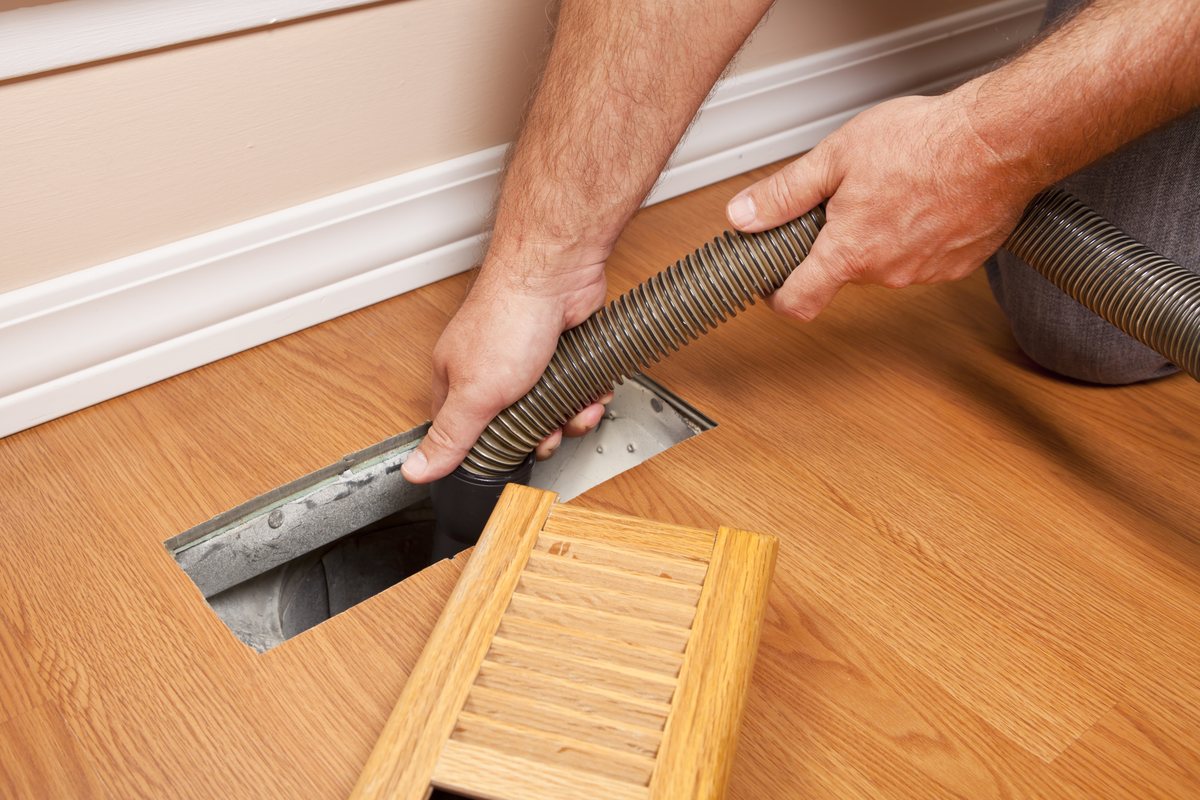
Here is how to clean air ducts yourself in a typical Toronto house: switch the furnace off, wash the vent covers, vacuum the first foot or two inside each supply and return opening with a shop vac and a soft brush, and put in a fresh filter. That part is safe, cheap and worth doing.
The trunk lines and long branch runs inside the walls and basement ceiling are a different job. They need equipment that pulls on the whole system at once, which is what our professional air duct cleaning crews bring on the truck. Below are the tools, steps and safety rules for the part you can reach, and an honest look at where DIY stops.
What You Can Clean Yourself, and What You Can’t
Supply ducts carry air from the furnace to the registers in each room. Return ducts bring it back through the larger grilles and the filter. From inside the house, you can realistically clean your own air ducts at these points:
- supply registers and return grilles
- the register boot (the sheet-metal box behind the cover) and the first foot or two of duct
- the furnace filter
- the blower compartment, for a look and the loose dust on its floor, with the power off
Out of reach: the main trunks in the basement ceiling, the branch lines running up inside walls, and, in many older GTA houses, panned returns, where a joist space covered with sheet metal serves as the return duct. In our experience, that is where most of the dust actually sits.
How to Clean Air Ducts Yourself, Step by Step
This routine covers how to clean vents in a house with forced-air heat: registers, returns and the first stretch of ductwork. Pick a mild spring or fall day and plan on an afternoon for a house with 10 to 15 vents.
Tools for DIY duct cleaning
- a shop vac with a fine-dust filter or bag, so fine dust is not blown back into the room
- a crevice tool, a soft brush attachment and a long, flexible dusting brush
- a screwdriver for wall and ceiling registers
- microfibre cloths, warm water with dish soap and an old towel
- an N95 dust mask, safety glasses and a flashlight
- paper towels or cheap filter media, plus painter’s tape
- a new filter in the size printed on the edge of the old one
Safety first
- Set the thermostat to off, then turn off the furnace service switch. It looks like a light switch and sits on the furnace or on a wall nearby.
- Open only the filter door and the blower door. Leave the wiring, gas valve and burner alone.
- A rotten-egg or sulphur smell means gas. Leave without touching light switches and call Enbridge Gas at 1-866-763-5427 or 911 from outside.
The steps
- Remove the covers. Floor registers lift out, wall and ceiling ones unscrew. Keep the screws in a cup so none drop into a duct.
- Wash the covers. Soak metal registers in warm soapy water, scrub, rinse and dry them completely so they do not rust. Wipe plastic and wood grilles instead.
- Clean out the boot. Pull loose debris out with the crevice tool, then brush the sides. Floor boots in kids’ rooms usually hold the most.
- Brush and vacuum the first stretch. Work only as far as your flashlight shows, about one to two feet. Brush toward the opening while the nozzle sits right at it, so loosened dust goes into the hose instead of deeper into the duct.
- Wipe, do not wash. A well wrung-out microfibre cloth lifts the grey film on the boot walls. Never pour water or spray cleaners into a duct, because damp dust is exactly what mold needs.
- Clean the returns. Lint and pet hair mat on the back of the larger return grilles. Vacuum both sides, then the opening behind.
- Change the filter. Point the airflow arrow toward the furnace. CMHC advises checking furnace filters monthly during the heating season and cleaning or replacing them as needed.
- Check the blower compartment. Take off the lower furnace door and shine a light on the blower wheel. Thick grey felt packed between the blades means it is time for a professional cleaning. Vacuum only the loose dust on the compartment floor.
- Catch what you knocked loose. Put the covers back, tape a paper towel over each supply register, close the furnace door, restore power and run the fan only (no heat or cooling) for about 15 minutes. The grey on those towels would otherwise have landed on your furniture.
How to Clean AC Ducts in a House With Central Air
Most GTA houses with central air use one set of ducts for heating and cooling. The AC coil sits on top of the furnace, and the same blower pushes air through the same supply ducts, so cleaning heating and air conditioning ducts yourself is one job with the steps above.
Leave the coil alone. Its thin aluminum fins bend at a touch, it sits in a sealed cabinet, and a musty smell or a dirty coil is work for a licensed HVAC technician. Our duct packages do not include the coil, but AC coil cleaning can be added to a visit by quote, and our technicians will tell you what they see.
Many Toronto condos use a fan coil or heat pump unit in a closet with short duct runs. DIY there is limited to the grilles and filter, and our condo duct cleaning service handles the rest.
Can You Disinfect or Sanitize Air Ducts Yourself?
Not in a useful way. A spray from a can reaches the first foot of duct, leaves a residue that blows back into the rooms, and does nothing about the dust farther in. Bleach is harsh on metal, and you will breathe the fumes once the fan starts.
Sanitizing only makes sense after a full mechanical cleaning, with a product made for HVAC systems. More on that in our post on whether sanitizing air ducts is really necessary.
Visible mold means moisture got in, from a leak, a wet basement or a sweating AC line. CMHC guidance is to fix the water problem first, then clean, and scrubbing mold out yourself only spreads it.
What You Can’t Reach When You Clean Air Ducts Yourself
The two-foot rule
The “two-foot rule” is not a building code, and people use the phrase in different ways. For cleaning it is a fair rule of thumb: from a register, a homeowner can clean roughly the first two feet of duct. Past that you cannot see, cannot steer a brush around the first elbow, and cannot collect what you knock loose.
Why suction is the real limit
A shop vac pulls air at one spot, the tip of the hose. Dust you loosen three metres down a branch line has nowhere to go, so it settles at the next low spot or blows into a room when the blower starts.
Professional equipment works the other way around. A truck-mounted, high-suction vacuum connected to the main trunk puts the whole system under negative pressure, so loosened dust is pulled toward the truck from every register.
The risk of damage
Flexible duct, common in basement renovations and additions, tears easily and can be pulled off its fitting, which dumps heat into the ceiling instead of the room. Fibreglass-lined duct sheds fibres when scrubbed, and old joints can be knocked apart into leaks you will never see.
What We See on the Job
After more than four decades of cleaning ducts across Toronto and York Region, the same patterns keep showing up.
- Clean registers, dirty returns. The heavy dust usually sits in the main return trunk just before the filter, where all the air in the house passes before anything catches it.
- Floor boots as lost and found. Toys, coins, hair elastics and pet kibble, especially in kids’ rooms.
- Renovation dust. Pale drywall dust in every line when the furnace ran during a reno. Our post-renovation duct cleaning guide covers that case.
- DIY damage. Flex runs pulled off their fittings after a drill brush went in too far. Not common, but it happens.
- Missing or backwards filters. An empty filter slot, or the arrow pointing the wrong way.
When to Call a Professional, and When You Don’t Need One
Plenty of homes do fine with the routine above and regular filter changes. You probably do not need us this year when the registers look clean a foot in, the filter is changed on schedule, nobody has renovated, and nothing unusual blows out of the vents.
The U.S. EPA makes no blanket recommendation and notes that duct cleaning has not been shown to prevent health problems. Its guidance on having air ducts cleaned says to consider it for substantial visible mold inside hard-surface ducts, rodents or insects in the ducts, or ducts clogged with dust and debris that blows out of the registers.
We would add moving into a house (CMHC mentions newly built ones too), the end of a renovation, and a flashlight check that shows thick dust past where you can reach. Our list of signs you need air duct cleaning goes further.
One honest limit: we clean, we do not repair furnaces or do gas work. When our technicians see something unsafe, they point it out and photograph it so you can call a licensed HVAC or gas technician.
Our air duct cleaning for Toronto and the GTA covers the trunk lines, branch runs and returns with truck-mounted negative-pressure equipment. Call 905-738-1878 or request a quote, and we confirm the total by phone before you book.
DIY vs Professional Duct Cleaning at a Glance
| Factor | DIY with a shop vac | Professional cleaning |
|---|---|---|
| Reach | Registers, boots and the first 1 to 2 feet of each duct | Registers, branch lines, main trunks and returns, end to end |
| Suction | One point at the tip of the hose | Whole system under negative pressure from a truck-mounted vacuum |
| Agitation | Hand brush and soft attachments | Brushing through each line while the vacuum pulls |
| Furnace blower | A look with a flashlight, loose dust only | Blower compartment cleaned with the Luxury package ($499) |
| Time | An afternoon | Typically a few hours for an average house |
| Cost | Tools you probably own, plus a new filter | Packages from $329 (up to 10 vents) to $499 (up to 15 vents), extra vents $12 each |
| Best for | Upkeep between cleanings, pet hair at the grilles, fishing out dropped items | Moving in, after a renovation, never-cleaned systems, debris blowing from registers |
Package details are on our duct cleaning prices page, and there is no trip fee.
Frequently Asked Questions
Can I vacuum air vents myself?
Yes. Vacuuming the registers, return grilles and the first foot or two of duct behind them is safe and useful. Turn the furnace off first, use a shop vac with a fine-dust filter and a soft brush, and avoid pushing debris deeper. A household vacuum handles the grilles but loses suction quickly inside the duct.
What is the 2 foot rule for ducts?
It is a rule of thumb, not a code. For DIY cleaning it means a homeowner can realistically clean only about the first two feet of duct from each register. Beyond that you cannot see, steer a brush around elbows or collect the dust you loosen, which is why deeper lines need professional negative-pressure equipment.
What do professionals use to clean air ducts?
Professional crews connect a high-suction, truck-mounted vacuum to the main trunk so the whole duct system is under negative pressure. They then brush each branch line from the registers, so loosened dust is pulled toward the truck instead of into the rooms. Returns get the same treatment, and before and after photos show what came out.
What happens if you never clean your air ducts?
In many homes, nothing dramatic. Dust builds up in the return trunk and register boots, filters load up faster, and in bad cases debris restricts airflow to some rooms. The U.S. EPA notes duct cleaning has not been shown to prevent health problems, so the real reasons to clean are visible debris, mold, pests, renovation dust or moving in.
Can I clean air ducts with a wet rag?
Use a damp cloth, not a wet one. Wring a microfibre cloth out well and wipe the register boot and the first stretch of duct you can reach by hand. Never pour water or spray cleaners into a duct, and let everything dry before restarting the furnace, because damp dust inside ductwork is what mold needs to grow.
Are DIY air duct cleaning kits worth buying?
For most homeowners, a soft brush and a shop vac do the useful part. Drill-powered brush kits can help on the first few feet of straight metal duct, but they can tear flexible or lined duct and loosen more dust than a shop vac can catch. A rented vacuum has the same limit: no access to the trunk lines.