
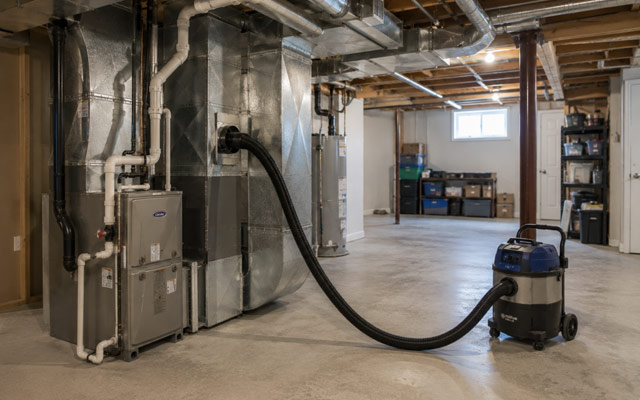
Many homeowners have heard of air duct cleaning, but few understand how air duct cleaning works or what actually happens during the service.
Does the technician simply vacuum the vents? Is the furnace cleaned too? What equipment is used, and what results should you realistically expect?
The service uses a structured source-removal process designed to remove dust, lint, and other accumulated debris from accessible ductwork without releasing contaminants back into the home.
This guide explains how air duct cleaning works, what parts of the HVAC system are typically cleaned, what equipment professionals use, and what homeowners should realistically expect from the service.
What Is Included in Duct Cleaning?
The process focuses on one specific part of the HVAC system: the network of supply and return ducts that distributes heated or cooled air throughout the home.
Over time, dust, lint, pet hair, construction debris, and other airborne particles can settle inside these ducts. Professional cleaning removes this accumulated material using specialized equipment designed to capture debris rather than release it back into the living space.
However, duct cleaning is often confused with other HVAC services. While the same company may offer furnace maintenance, coil cleaning, or duct repairs, those are separate procedures that address different issues.
| What the Service Covers | What It Does Not Cover |
|---|---|
| Remove dust and debris from accessible ductwork | Repair HVAC equipment |
| Clean supply and return ducts | Replace air filters |
| Clean registers and grilles | Seal leaking ducts |
| Remove buildup from airflow pathways | Fix airflow design problems |
| Improve the cleanliness of the duct system | Solve every indoor air quality issue |
Knowing this distinction helps set realistic expectations.
For example, if poor airflow is caused by a failing blower motor or leaking ductwork, cleaning alone will not resolve the problem. Likewise, household dust generated by carpeting, furniture, pets, or everyday activities will continue to accumulate after the ducts have been cleaned.
The U.S. Environmental Protection Agency also notes that duct cleaning is most appropriate when there is a specific reason to remove contaminants—such as substantial dust buildup, visible debris, or contamination following certain events—rather than as routine maintenance for every home.
How Air Duct Cleaning Works: Step by Step
Although the equipment may vary from one contractor to another, the cleaning process itself follows the same basic sequence. Each step is designed to remove debris while preventing it from circulating back into the home.
Step 1 — Inspecting the HVAC System
Every professional cleaning begins with an inspection.
Before any equipment is connected, technicians examine the HVAC system to identify supply and return ducts, locate access points, and assess the condition of the ductwork. This allows them to determine where debris has accumulated and whether there are any issues—such as damaged ducts or disconnected sections—that require repair rather than cleaning.
The inspection also helps technicians choose the safest cleaning method for the type of ductwork installed in the home.
Step 2 — Creating Negative Pressure
Once the system has been inspected, a high-powered vacuum is connected to the ductwork.
The vacuum creates continuous negative pressure, which is one of the most important parts of the entire process.
Rather than allowing loosened dust to escape through supply vents, the airflow pulls debris toward the collection unit as soon as it becomes airborne. Without negative pressure, cleaning tools could simply stir up contaminants and redistribute them throughout the house instead of removing them.
Truck-mounted and portable vacuum systems can both be effective, provided they generate enough airflow to maintain continuous suction throughout the cleaning process.
Step 3 — Loosening Dust and Debris
With the vacuum system running, technicians begin loosening dust and debris from the inside surfaces of the ductwork.
Over months or years, airborne particles do not simply lie loose inside the ducts. Many cling to metal or flexible duct surfaces, especially around bends, joints, and branch lines. Because of this, suction alone cannot remove all of the buildup.
Instead, technicians use specialized agitation tools to break debris free while the vacuum continuously pulls it toward the collection unit.
The exact tools depend on the type of ductwork. Rigid sheet-metal ducts can often be cleaned with rotary brushes, while flexible ducts typically require gentler compressed-air tools that minimize the risk of damaging the inner liner.
Regardless of the equipment used, the objective remains the same: loosen accumulated debris without damaging the ductwork.
Step 4 — Removing the Debris
As dust and debris are loosened, the vacuum system immediately draws them out of the ductwork and into a sealed collection unit.
This method, known as source removal, is widely recognized as an industry-standard approach to professional duct cleaning because contaminants are physically removed from the HVAC system rather than simply pushed from one section of the ductwork to another.
Throughout the cleaning process, negative pressure remains active, helping prevent dust from escaping through supply vents and into occupied living spaces.
Step 5 — Final Inspection
Once the cleaning is complete, technicians perform a final inspection of the accessible components.
Registers and grilles are reinstalled, any service openings created during the cleaning are properly sealed, and the HVAC system is returned to normal operation.
Some contractors also provide before-and-after photographs of accessible duct sections, allowing homeowners to see the results of the cleaning.
It is important to note that this final inspection is not a full HVAC inspection. Its purpose is simply to confirm that the duct cleaning has been completed correctly and that the system is ready for normal operation.
Our duct cleaning experts remove dust, debris, and buildup from your air ducts, helping your home or business feel fresher, cleaner, and more comfortable.
What Parts of the HVAC System Are Usually Cleaned?
One of the biggest misconceptions about the service is that every part of the HVAC system is cleaned.
In reality, the primary focus is the air distribution system—the ducts and components that carry conditioned air throughout the home. Mechanical repairs and routine HVAC maintenance are separate services.
The exact scope may vary slightly between contractors, but a standard residential service typically includes the following:
| Usually Cleaned | Usually Not Included |
|---|---|
| Supply air ducts | Furnace repair |
| Return air ducts | Blower motor servicing |
| Main trunk lines | Air filter replacement |
| Registers and grilles | Thermostat servicing |
| Accessible branch ducts | HVAC repairs |
Some companies also offer evaporator coil cleaning or blower cleaning, but these are often priced as separate HVAC maintenance services rather than being included in a standard duct cleaning package.
Because every home is different, accessibility also plays a role. Sections of ductwork hidden inside finished walls or ceilings may not be reachable without opening the building structure. A reputable contractor should clearly explain what is—and is not—included before work begins.
What Equipment Is Typically Used?
Professional duct cleaning relies on specialized equipment designed to remove debris from the HVAC system without releasing it into the home. While the exact tools vary between contractors, most residential duct cleaning services use the same three types of equipment.
While different contractors may use different equipment, the cleaning method is ultimately more important than the specific brand of vacuum or tools. A thorough service combines continuous negative pressure with mechanical agitation to physically remove contaminants from the HVAC system rather than simply moving them from one area to another.
How Long Does Air Duct Cleaning Usually Take?
The time required depends on the size of the home, the complexity of the duct system, and the amount of debris inside the ducts. A small condominium can usually be cleaned much faster than a large detached home with multiple levels and an extensive HVAC system.
Typical cleaning times are shown below.
| Property Type | Typical Cleaning Time |
|---|---|
| Condo or apartment | 2–3 hours |
| Small detached home | 3–4 hours |
| Average detached home | 4–6 hours |
| Large or multi-level home | 5–8 hours |
Actual cleaning time may vary depending on the number of supply and return vents, the accessibility of the ductwork, and the overall condition of the HVAC system. A quality service should focus on thorough debris removal rather than completing the job as quickly as possible.
What Results Should You Expect?
A thorough cleaning removes accumulated dust and debris from accessible parts of the HVAC system, but it is important to have realistic expectations about what the service can—and cannot—do.
If significant buildup was present before cleaning, homeowners may notice cleaner supply registers, less visible dust around vents, or improved airflow in certain rooms. Some also report a reduction in stale odors caused by dust or debris inside the ductwork.
However, duct cleaning is not a cure-all for indoor air quality problems. Dust will continue to enter the home through everyday activities, open doors and windows, pets, fabrics, and outdoor air. Regular filter replacement and proper HVAC maintenance remain just as important.
| You May Notice | You Should Not Expect |
|---|---|
| Cleaner supply registers | Instant relief from allergies or asthma |
| Less dust blowing from vents | Every indoor air quality issue solved |
| Cleaner duct interiors | HVAC repairs |
| Better airflow where debris was restricting passages | Immediate reductions in energy bills |
| Removal of accumulated dust and lint | Permanent elimination of household dust |
The U.S. Environmental Protection Agency also notes that there is insufficient evidence to recommend routine duct cleaning for every home. Instead, the service is most appropriate when there is visible contamination or another specific reason to clean the system.
When Does Duct Cleaning Make Sense?
The service delivers the greatest value when there is a clear source of contamination inside the HVAC system rather than simply as part of a routine schedule.
Professional cleaning is commonly recommended:
If you are unsure whether your system needs cleaning, review the signs you need air duct cleaning before booking the service.
When Duct Cleaning Usually Does Not Help
While duct cleaning removes contaminants from inside the ductwork, it cannot solve problems that originate elsewhere in the HVAC system.
Cleaning alone is unlikely to fix:
Homeowners should also be cautious of companies that promise dramatic health improvements or claim that duct cleaning will permanently eliminate dust or allergies. These claims are not supported by current evidence and often appear in misleading advertising.
Our duct cleaning experts remove dust, debris, and buildup from your air ducts, helping your home or business feel fresher, cleaner, and more comfortable.
Frequently Asked Questions
How often should air ducts be cleaned?
There is no universal schedule. Cleaning should be based on the condition of the HVAC system, not simply on the number of years since the last service. Renovations, excessive dust buildup, pest activity, or visible contamination are more meaningful indicators than a fixed timetable.
Can I stay home during air duct cleaning?
Yes. Most homeowners remain at home while the work is performed. Because the equipment can be noisy and technicians need access to vents throughout the house, some families choose to keep children or pets in a separate area until the cleaning is complete.
Does air duct cleaning create dust inside the house?
No—when performed correctly. Professional cleaning uses continuous negative pressure to capture loosened debris before it can escape into living spaces. While a small amount of dust may be created during equipment setup, the cleaning process itself is designed to contain contaminants rather than spread them.
Do all homes need professional air duct cleaning?
No. According to the EPA, air duct cleaning is generally recommended only when there is visible contamination or another specific reason to clean the system. Many homes do not require routine duct cleaning as part of regular HVAC maintenance.